Reputation Radar #21: Hard to Block, Harder to Take Down
BADBOX is back for a third round, turning cheap Android TV boxes into the biggest ad-fraud operation ever disclosed and feeding eleven residential proxy networks. Meanwhile Talos maps how attackers park command-and-control data on public blockchains, where nobody can delete it. Plus vCenter and Cisco Expressway zero-days, Azure API Management, a poisoned Microsoft PyPI package and NGINX2Root.
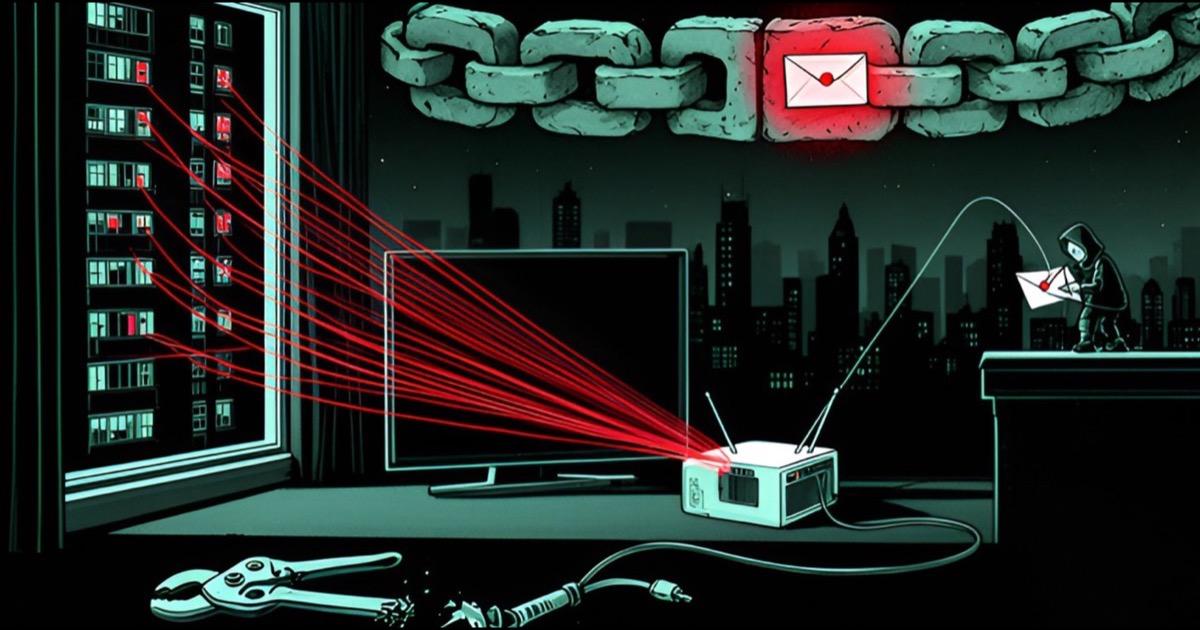
The last two issues were about trusted places doing something they shouldn't: proxy exits on the White House network, malware served by the BBC's own homepage. This week's two stories are about the other half of the problem: infrastructure built so that taking it down barely matters.
One lives in millions of living rooms. The other lives on a public ledger that, by design, nobody can edit.
BADBOX, round three
HUMAN's Satori team, working with Google and Shadowserver, disrupted BADBOX 3.0 last week, and the numbers are hard to take in. At its peak the operation produced around 40 billion fraudulent ad bid requests a day, more than 4% of all connected-TV traffic HUMAN sees and over three times the previous record holder, as BleepingComputer reported from HUMAN's write-up.
The way in hasn't changed since the first version. The malware comes preinstalled on cheap, uncertified Android TV boxes, tablets and phones, so the device is compromised the moment someone plugs it in. HUMAN tied the infrastructure to a Chinese electronics maker, TXCZ, through device software, domains, servers and code repositories. On the ad side, the boxes played video ads in hidden windows while pretending the requests came from real streaming apps, and a server-side variant faked ad traffic without needing a device at all.
The part that matters for this series is what else the boxes did. Infected devices were enrolled in eleven residential proxy networks without their owners knowing. One of them, PXYEDGE, looks like a comeback of IpMoYu, the proxy service exposed during BADBOX 2.0. It advertised about 200,000 nodes, and HUMAN recorded 340,000 unique connections at its peak. Somebody was renting out those living-room connections by the hour.
And the operators had thought about takedowns. According to HackRead's summary, the boxes pulled their modules from public code repositories, with backup copies on CDNs and other platforms, so losing a server meant swapping in another. Google took down command-and-control domains and a malware repository was removed. The boxes themselves are still sitting under televisions, running the same preinstalled firmware.
The dead drop nobody can delete
Cisco Talos published a long look at a technique that keeps spreading: storing encrypted command-and-control configuration inside blockchain transactions and smart contracts. The malware doesn't talk to a server the attacker owns. It makes a read-only query to a public blockchain node, pulls the current config into memory, and only then connects to wherever it's told.
Talos lists a crowd of users. EtherHiding contracts on Ethereum and BNB Smart Chain for the ClearFake fake-update campaigns, North Korean groups using it for JADESNOW and INVISIBLEFERRET, Lazarus moving to Solana memo transactions this March, an Overlord RAT operator in September, and Iranian state actors on TRON.
What makes it "bulletproof" is permanence. In Talos's words: "Once a transaction is confirmed by the validators, it becomes a permanent, globally replicated record... no single entity, cloud provider, or law enforcement agency possesses the administrative authority to delete, overwrite, or withhold that data." Seize the domain the config points to and the attacker just writes a new transaction. And reading it is cheap and quiet: "By executing read-only remote procedure call (RPC) queries to retrieve encrypted C2 configurations directly into compromised endpoint memory, adversaries can continuously bypass traditional perimeter defenses and domain seizures."
What the reputation column shows
For BADBOX, the exits are the hard part, and we've said it before about phones and White House laptops. A TV box on a home broadband line has the reputation of a home broadband line. No list will reliably tell you which of millions of consumer addresses is a proxy node this afternoon.
The blockchain side is more interesting to check, because the infrastructure has names. We ran the public RPC endpoints these families lean on, like mainnet.infura.io, bsc-dataseed.binance.org, api.trongrid.io, api.mainnet-beta.solana.com, rpc.ankr.com and QuickNode, through our API. Every one comes back as a popular, legitimate domain, with the investigate verdict and the hint that popularity alone isn't trust.
That's the right answer for the domain, and it's also why this technique works. These are real services that wallets, exchanges and developers hit all day. Blocking them would break things, and no threat feed is going to list Binance's own node as malicious. The signal has to come from who is making the call:
- Endpoints that have no business with crypto. A finance laptop or a build server making
eth_callrequests to a BNB Smart Chain node is worth a question. Talos suggests baselining normal developer use and flagging automated, high-frequency RPC calls. - What's inside the JSON-RPC. Talos recommends inspecting RPC payloads for odd base-encoded data, and watching for the lightweight in-memory decryption that comes right before the first beacon.
- The TV box segment. Cheap streaming boxes don't belong on the same network as anything you care about. If you find them on a corporate or guest network, look at how much outbound traffic they generate to ad and proxy infrastructure, and replace uncertified devices rather than trying to clean them.
Also on the radar
- vCenter, exploited for two months before the patch. Google's threat intelligence team and Mandiant tied CVE-2026-123890, a 9.8-rated flaw that hands an unauthenticated attacker an administrator session on vCenter, to the China-nexus group they now call Armory Castle, formerly UNC5221, active since early September (Help Net Security). They got in through a BeyondTrust zero-day, forged SAML tokens to get past MFA, and pulled Active Directory databases out of victim VMs. Broadcom's fix is VMSA-2026-0009, with no workaround.
- Cisco Expressway, from the edge to the cluster. CVE-2026-76466 lets an unauthenticated attacker run commands as root on clustered Expressway deployments through bad client-certificate checks. F6 found attackers breaking into internet-facing Edge nodes, hopping to internal cluster nodes and stealing credentials from GitLab repositories (Help Net Security). It went into CISA's catalog on November 20th. If you can't update to X15.5.20 yet, restrict TCP 4371-4372 to the cluster nodes.
- Azure API Management secrets, taken before the fix. A flaw in APIM Classic tiers let attackers reach management functions and steal secrets stored in Named Values, subscription keys and identity provider client secrets; Norwegian authorities linked it to attacks on Equinor and Skagerak Energi (BleepingComputer). Microsoft mitigated it on November 19th but warns it "does not automatically invalidate credentials that may have been accessed before the fix was deployed," so anything stored in APIM needs rotating.
- Microsoft's own package, poisoned. Versions 1.26.1 and 1.26.2 of
agent-frameworkon PyPI shipped the real code plus a stealer for Azure, Azure DevOps and GitHub Actions credentials, published 33 minutes apart on November 17th (SecurityWeek). OX Security, Wiz, Endor Labs and SafeDep all analysed it. The nasty detail: "The malware runs whenever the Python interpreter starts, even if the application doesn't explicitly import the compromised package." - NGINX2Root, with honest caveats. Rapid7's Stephen Fewer found CVE-2026-123007, an integer underflow in nginx's HTTP/2 flow control that can lead to code execution (Rapid7). It needs HTTP/2 over TLS, around 119 GiB of traffic, a fast link and specific CPU features, so mass exploitation looks unlikely. It's still nginx on a huge share of the internet: update to 1.31.9 or 1.30.7, or turn HTTP/2 off where you don't need it.
If you want the longer read on why a legitimate, popular result in the reputation column is where the question starts, we walked through it in Borrowed reputation: when attackers hide behind trusted infrastructure.
See you next week.
Sources are linked inline, with credit to HUMAN's Satori team for the BADBOX 3.0 research, to Cisco Talos for the blockchain dead-drop analysis, and to the original researchers and vendors. If we got a detail wrong, tell us and we'll fix it.
About Reputation Radar: This is written by the small team building Reput.io, not a marketing department. It's our weekly read on the infosec landscape, with a bias toward the thing we care most about: how attackers borrow the reputation of legitimate infrastructure so their traffic looks normal. Every item links the original reporting, and any claim about our own API is run against it live and labelled.
Ready to Try Reput.io?
Start reducing false positives today with our free plan.